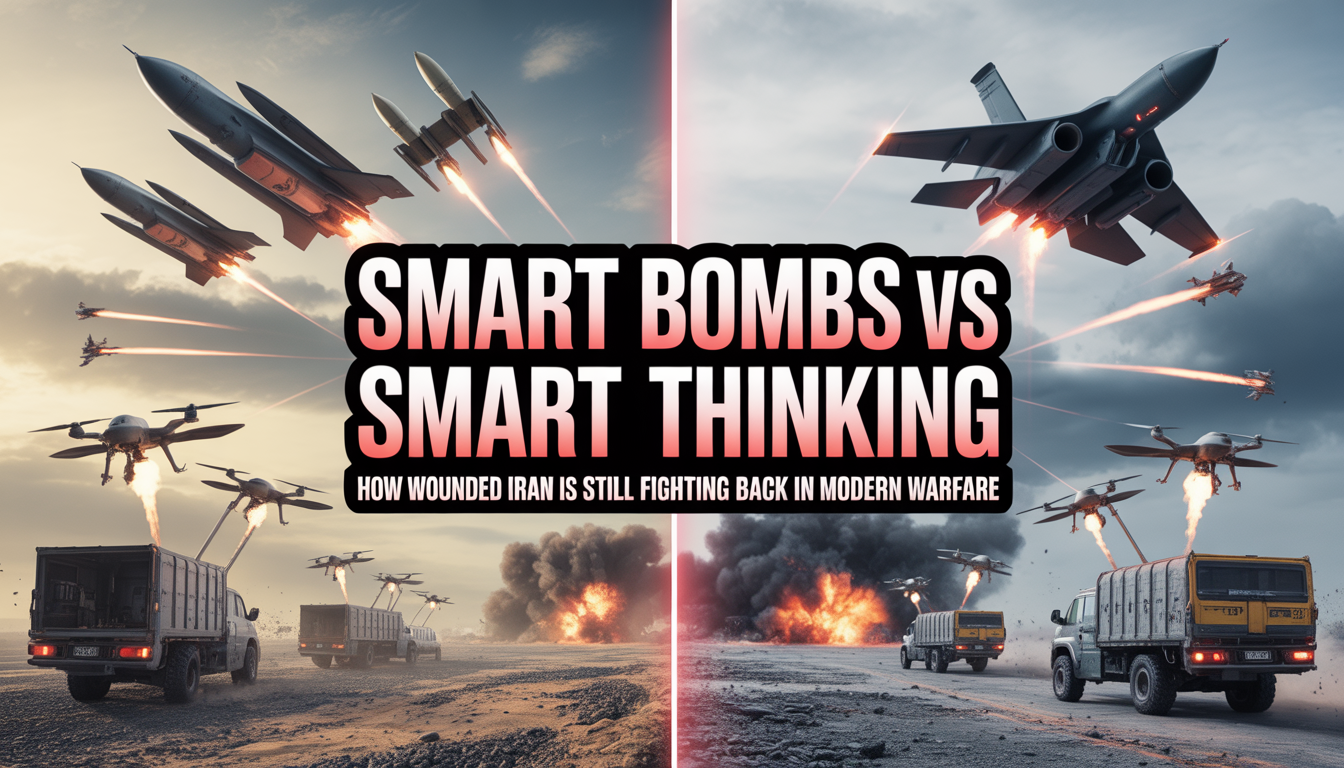
Modern warfare is no longer defined only by the most expensive weapons or the most advanced technology. Increasingly, it is about strategy, economics, and the ability to outthink a stronger opponent. The recent conflict involving Iran, Israel, and the United States has shocked many observers around the world. Many analysts initially assumed that a technologically superior alliance would quickly dominate the battlefield. Yet the situation has turned out to be far more complicated. Despite heavy pressure, sanctions, and military attacks, Iran has managed to continue fighting and even trouble far stronger military powers. The conflict has revealed an important lesson: sometimes smart thinking, unconventional tactics, and cost-effective weapons can challenge even the most sophisticated military systems in the world.
The Shock of Iran’s Ballistic Missile Strikes:
Recent missile attacks have demonstrated that Iran possesses a growing arsenal of advanced ballistic weapons. One example is the Khyber Shekan missile, which can carry multiple small warheads capable of spreading across a wide area. Instead of relying on a single large explosion, such weapons can release numerous smaller payloads that increase the chances of causing damage.
Missile attacks on Israeli territory, including areas around Tel Aviv, have raised serious concerns about the effectiveness of modern missile defense systems. When multiple warheads or cluster munitions are released, intercepting every single one becomes extremely difficult. Even the most advanced missile defense networks can be overwhelmed if enough projectiles are launched simultaneously.
These developments have shown that modern conflicts are not simply about having powerful weapons. They are also about designing strategies that exploit weaknesses in defensive systems.
The Role of Drones in Changing the Battlefield:
Another major factor in this conflict has been the use of inexpensive drones. Iranian Shahed drones have gained global attention because of their relatively simple design and low production cost.
These drones are far cheaper than the missiles used to intercept them. A Shahed drone can cost tens of thousands of dollars, while interceptor missiles used to destroy them can cost millions. This difference creates a major economic imbalance during prolonged conflicts.
Iran has frequently launched these drones in large groups. When dozens or even hundreds of drones approach a target at once, defensive systems must respond quickly and repeatedly. Even if most drones are intercepted, the cost of stopping them can become extremely high.
This strategy demonstrates how relatively inexpensive weapons can create serious problems for technologically advanced militaries.
The Economic Strategy Behind Missile and Drone Warfare:
One of the most striking aspects of this conflict is the economic dimension of modern warfare. Iran appears to be using a strategy that focuses not only on physical damage but also on exhausting the enemy’s defensive resources.
Interceptor systems such as THAAD, Patriot, and Arrow missiles are extremely sophisticated but also extremely expensive. Each defensive missile may cost between one million and fifteen million dollars. In comparison, many drones and short-range missiles used in attacks cost only a fraction of that amount.
By launching large numbers of inexpensive drones and missiles, Iran forces its opponents to spend far greater resources on defense. Even if defensive systems successfully intercept most incoming threats, the financial cost can quickly become enormous.
This approach highlights a new reality of warfare where economic sustainability becomes just as important as military strength.
Iran’s Underground Missile Infrastructure:
Another factor that has contributed to Iran’s resilience is its extensive underground missile infrastructure. Reports and videos released by Iranian military organizations have shown massive tunnel networks used to store and launch missiles.
These underground facilities stretch for kilometers and contain launch platforms prepared for rapid deployment. By placing weapons underground, Iran protects them from airstrikes and surveillance.
Such infrastructure makes it extremely difficult for opposing forces to eliminate missile capabilities. Even if some launchers are destroyed, others may remain hidden and operational.
This strategy ensures that Iran can continue launching missiles even under intense military pressure.
Hypersonic Missiles and the Challenge of Interception:
Iran has also developed faster and more advanced missile technology. One example frequently discussed is the Fattah-2 hypersonic missile. Hypersonic weapons travel at extremely high speeds, sometimes reaching more than fifteen times the speed of sound.
At such speeds, traditional missile defense systems struggle to track and intercept them. Hypersonic missiles can also change their trajectory during flight, making them even harder to stop.
The emergence of these weapons has forced military analysts to reconsider existing defense strategies. Systems designed to intercept slower ballistic missiles may not always be effective against hypersonic threats.
This technological development adds another layer of complexity to modern warfare.
The Origins of Iran’s Drone Technology:
Iran’s drone capabilities have evolved significantly over the past decade. One notable event occurred in 2011 when an advanced American surveillance drone crashed in Iranian territory.
This drone, the RQ-170 Sentinel, was considered one of the most sophisticated unmanned aircraft in the world at the time. After recovering the drone, Iranian engineers reportedly studied and reverse-engineered its technology.
From this research, Iran developed several new drones, including the Shahed-171, Shahed-191, and the widely known Shahed-136. These drones range from surveillance platforms to kamikaze-style weapons designed to strike targets directly.
The development of these drones demonstrates how captured technology can influence future military innovation.
The Complex Web of Missile Defense Systems:
Israel and its allies operate one of the most advanced missile defense networks in the world. This system includes multiple layers designed to intercept different types of threats.
At higher altitudes, systems such as Arrow missiles attempt to destroy long-range ballistic missiles before they enter the atmosphere. At intermediate ranges, systems like David’s Sling intercept medium-range threats. Closer to the ground, the famous Iron Dome system targets short-range rockets and drones.
In addition, the United States has deployed systems such as THAAD to intercept ballistic missiles both inside and outside the atmosphere. These layered defenses create a complex protective shield around key areas.
However, even the most advanced defensive network has limitations when facing large numbers of incoming projectiles simultaneously.
The Strategy of Volley Fire and Decoys:
Iran has attempted to overcome these defenses through a strategy known as volley firing. Instead of launching one missile at a time, large numbers of drones, cruise missiles, and ballistic missiles are launched together.
In such attacks, drones often act as distractions. Defensive systems may prioritize intercepting them first, allowing more dangerous missiles to approach their targets.
Another tactic involves the use of decoys. Fake warheads or misleading signals accompany real missiles, confusing defensive radars and interceptors. By the time the defense system identifies the real threat, it may be too late.
These tactics show how strategic planning can reduce the effectiveness of even highly advanced military technology.
The Global Implications of This Conflict:
The ongoing conflict has broader implications for the future of warfare. Military strategists around the world are closely observing how relatively inexpensive technologies can challenge powerful defense systems.
Countries are increasingly studying the use of drones, missile swarms, and asymmetric strategies that rely on quantity and cost efficiency. Instead of focusing only on large traditional weapons, modern militaries are exploring ways to integrate smaller, more flexible technologies.
This shift suggests that future wars may be defined not only by technological superiority but also by adaptability and strategic thinking.
The Changing Definition of Military Power:
The events of this conflict have demonstrated that military power is evolving. Expensive fighter jets, advanced radars, and sophisticated missiles remain important, but they are no longer the only deciding factors.
Creative strategies, economic calculations, and unconventional tactics are becoming equally significant. In some situations, relatively simple weapons can disrupt highly advanced systems if used intelligently.
The concept of “smart thinking versus smart bombs” captures this shift perfectly. Military strength is no longer measured only by the price or sophistication of weapons but by the ability to use available resources effectively.
As warfare continues to evolve, one lesson becomes increasingly clear: intelligence, strategy, and adaptability may prove just as powerful as the most advanced weapons ever created.
Conclusion:
Modern warfare is no longer a simple contest of who has the most advanced weapons or the largest military budget. The evolving conflict involving Iran and its adversaries highlights a deeper truth: strategy, adaptability, and economic thinking can sometimes outweigh pure technological superiority.
Iran’s approach demonstrates how a nation under pressure can remain effective by using asymmetric tactics. Instead of matching powerful opponents weapon-for-weapon, it focuses on exploiting weaknesses whether through low-cost drones, missile saturation, underground infrastructure, or psychological and economic pressure. These methods reveal that even the most advanced defense systems have limits when faced with coordinated, high-volume, and unpredictable attacks.
At the same time, this conflict exposes the growing importance of sustainability in warfare. Winning is no longer just about destroying targets; it is also about maintaining the ability to continue fighting over time without exhausting resources. When cheaper offensive tools force expensive defensive responses, the balance of power becomes more complex.
Ultimately, the idea of “smart thinking vs smart bombs” reflects a major shift in how military power is defined. Technology still matters, but it is no longer enough on its own. The future of warfare will likely belong to those who can combine innovation, efficiency, and strategic intelligence to outmaneuver their opponents not just outgun them.
FAQs:
1. Why is Iran able to challenge more advanced military powers?
Iran uses asymmetric strategies such as low-cost drones, missile saturation, and underground infrastructure to exploit the weaknesses of more advanced but expensive defense systems. This allows it to remain effective despite technological gaps.
2. What is meant by “economic warfare” in this context?
It refers to strategies that force the enemy to spend significantly more resources on defense than the attacker spends on offense. For example, cheap drones can force the use of very expensive interceptor missiles.
3. Why are drones so important in modern warfare?
Drones are relatively inexpensive, easy to produce, and can be deployed in large numbers. When used in swarms, they can overwhelm defense systems and create both physical and financial pressure on the opponent.
4. Are advanced missile defense systems like Iron Dome or THAAD ineffective?
No, they are highly effective against many threats. However, they can be challenged by tactics like volley fire, decoys, and large-scale attacks, which test their limits and increase operational costs.
5. What does this conflict teach about the future of warfare?
It shows that future wars will rely not only on advanced technology but also on smart strategies, adaptability, and cost efficiency. Nations that can think creatively and use resources effectively may have an advantage, even against stronger opponents.